Bernard of Cluny by John Balnaves.
For further information contact ejb@prosentient.com.au
Home
| Intro
| Ch.1
| Ch.2
| Ch.3
| Ch.4
| Ch.5
| Ch.6a
| Ch.6b
| Ch.6c
| Ch.7
| Appendices
| Bibliography |
PDF (full thesis)
CHAPTER 6 METRE AND RHYME
Metre
Bernard of Morlaix was familiar with classical prosody, though his
quantities were not always those of the ancients. Two of his poems, De castitate servanda and In
libros Regum, are classical in metrical form. The first consists of 523
lines1 and the second of 1018 lines in elegiac
couplets and they are for the most part perfectly regular in metre. They have no
rhymes.
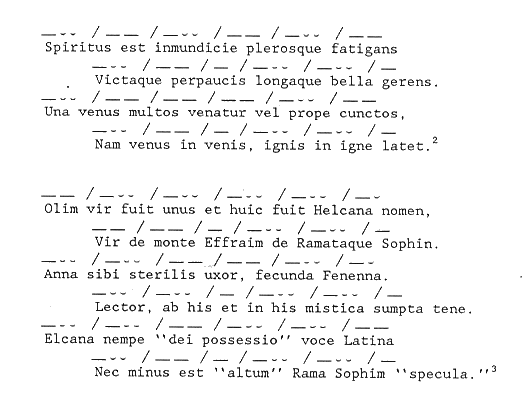
Bernard is well aware that his quantities are not always
classical, and that his metre is sometimes faulty. In the De castitate servanda, in the middle of a discussion of Saint Paul's
letter to the Thessalonians, and again in the In libros
Regum, in the middle of a commentary on a passage about Solomon's wealth (3
Kings 4,1-34), he apologises. He explains that it is not due to carelessness or
ignorance ("prudens atque sciens") but to problems of using non-classical words
("nescia nomina") in a classical metre and to his attempts to express his
meaning concisely ("forsan et obscurus fio brevis esse laborans").4
The Carmina
de Trinitate et de fide Catholica commences with reasonably regular
hexameters.
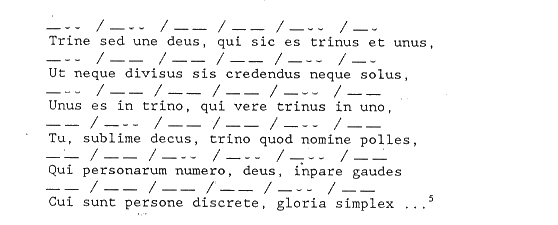
"Numero, deus, inpare gaudes" is
adapted from Vergil's eighth Eclogue (line 75), "numero deus inpare gaudet." The
regular metre of the hexameter continues until line 817. That is, more than half
the length of the poem, which has 1402 lines. At line 817 an internal rhyme is
introduced. Thereafter, internal rhymes appear sporadically until the end of the
poem.
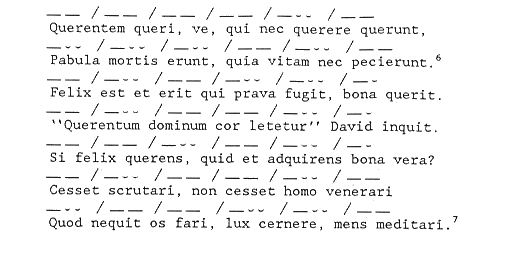
The first pair and the last pair of lines of the passage
quoted above (816-817 and 821-822) have end rhymes. Such end rhymes appear
sporadically and less frequently than internal rhymes, from this point on.
At line 1006, after a discussion of the second person of the
Trinity, Bernard has this comment on his metre:
Ipsi personam quasi fantem nunc tibi
ponam.
Metra carens zelo mea
maiorumque revelo.
Non mea
sunt tantum sed patrum metrificantum.
In cruce pendentem tibi nunc induco loquentem.
Accipe dicentem, dicenti porrige
mentem.8
Now I present the person of Christ, just as
if he were speaking to you yourself. I am not jealous of my forebears. The
metre I am using is theirs. It is not mine only, but also the metre of the
Fathers. I now present Christ hanging on the cross and speaking to you.
Listen to what he says. Open your mind to his words.
There follows a poetic rendering of imaginary words of
Christ from the cross. "I die that you might live. There is no greater love.
Think about who it is that is suffering for you, and how much I am suffering,
and why ..."9 The words of Christ continue for
forty-eight lines, all in the same metre, with internal rhymes but no end
rhymes. Then Bernard says:
Haec ita. Cetera iam planis tibi versibus
edam,
Danda Leonino quamvis
restent pede quaedam.
Ne
stupeas, lector, quia sepe Leonica sector.
Gratis grata sonis admisceo metra Leonis.
Nunc versus planos aro scilicet
Ovidianos,
Nam querunt illos
quidam, quidam magis istos.
Est aliud, quare metro parco Leonis arare:
Versus enervat qui verba Leonica servat,
Nec succintus erit qui dicta Leonica
querit.
Ergo conmixtos nunc
illos, nunc sequor istos.10
So much for that. The rest I will write for you in plain verses,
although certain parts will still be rendered in the Leonine metre. Do not
be surprised, reader, that, although I often follow the Leonine style, and
add to a pleasant metre the pleasant sounds of Leonine rhymes, I am now
ploughing straight furrows,11 like Ovid's
verses. The reason is that some people like the one kind of verse, while
others prefer the other. There is another reason why I do not always use the
Leonine metre. A poet who keeps to the Leonine style weakens his verses, and
a poet who uses Leonines will not express his meaning concisely. That is why
I sometimes use one metre and sometimes the other.
De octo vitiis also employs hexameters. Internal rhymes
are consistently used throughout all of its 1399 lines, and stress begins to
become as important as quantity in reading the poem.
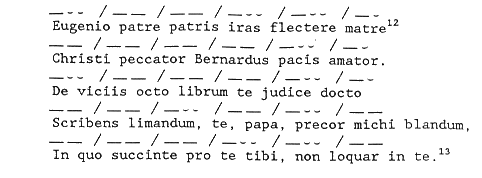
The prologue to the Mariale is in
the same metre with the same rhyme scheme.
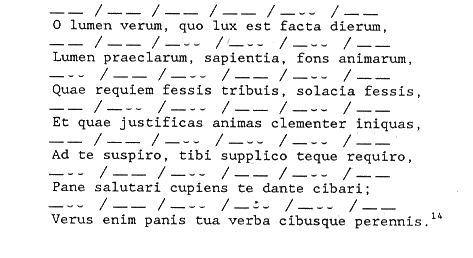
The De contemptu mundi, which, at about 3000 lines, is the
longest of the poems, is also in hexameters. There
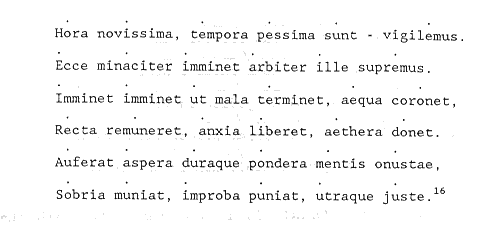
are both internal rhymes and end rhymes consistently throughout. The verse form
is called "dactylici tripertiti."15 It is
possible to read the metre quantitatively, ignoring the rhymes, but the effect
is monotonous, because every foot except the last of each line is a dactyl and
there is no caesura. The rhyme scheme demands that the metre be read according
to stress rather than quantity.
The effect
is similar to that of the Rhythmus in laude Salvatoris
of Peter the Venerable, which could not possibly be read quantitively. Nor,
since each "line" ends with a dactyl, does it give any impression of
hexameters.
Gaude, mortalitas,
Redit aeternitas,
Qua reparaberis!
Quidquid de funere
Soles metuere,
Iam ne
timueris.
Dat certitudinem
Vita per hominem
Et Deum reddita,
Quam
in se praetulit
Ac tibi
contulit
Morte deposita.17
The metre and
rhyme of the De contemptu mundi go well in Latin.
Ernst Robert Curtius writes of the "heights of impassioned greatness in
hexameters rhymed in couplets with double internal rhymes, as in Bernard of
Morlaix's poem on the Last Judgement and Paradise."18 They are very difficult to render in English. There were several
attempts at Englishing the metre and rhyme of small parts of the first book of
the poem in the wake of its popularisation as an English hymn by J.M. Neale in
the 1860's.19 None of them is successful. The
following, for example, is Charles Lawrence Ford's translation of the opening
lines:
Late is earth's history; ripe is sin's
mystery; slumber no more!
Vengeance is looming, the Arbiter dooming, the Judge at the door;
Nigher and nigher, to evil a
fire, of right the reward,
Paradise bringing, and crowning with singing the saints of the
Lord.20
Even Swinburne, with his facility for rhyme, did not manage much better.
Part of his translation goes as follows:
O land without guilt, strong safe city built
in a marvellous place,
I
cling to thee, ache for thee, sing to thee, wake for thee, watch for thy
face:
Full of cursing and
strife are the days of my life, with their sins they are fed,
Out of sin is the root, unto sin
is the fruit, in their sins they are dead.21
The rhythmi and the epilogue of the Mariale are similar to the De
contemptu mundi only in that their metrical systems are based on stress
rather than quantity, and that they use a consistent and complex rhyme scheme.
But the metre and rhyme scheme of the rhythmi are different from those of the
epilogue, and both are different from those of the De
contemptu mundi.
(...continues on Chapter 6b )